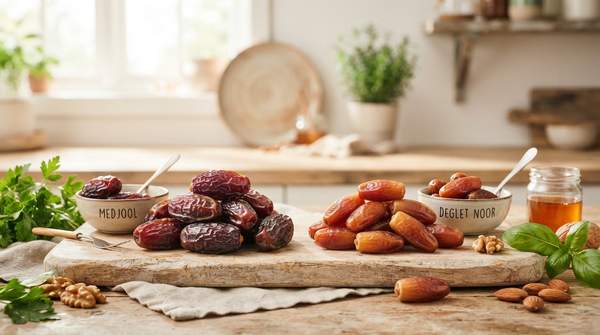
Both Medjool and Deglet Noor dates are nutritious dried fruits, but they are not identical. Per 100 grams, Deglet Noor dates edge out Medjool on fiber (8g versus 7g), while Medjool offers a bit more protein, potassium, magnesium, and copper. The differences are slight, so the smarter question is not which date is "healthier" but which one better matches your priorities, such as digestive support, mineral intake, or quick energy.
Medjool vs. Deglet Noor: A Nutritional Showdown
Medjool dates are larger, softer, and richer, often eaten on their own as a caramel-like snack or used as a natural sweetener. Deglet Noor dates are smaller and firmer, with a more delicate sweetness, and their lower moisture content means their nutrients are slightly more concentrated by weight. Jason Shopshear, a date farmer writing for Desert Sun Dates, put the two varieties side by side and concluded that the nutritional differences are "slight but worth noting depending on your dietary needs."
That framing is accurate: per 100 grams, the two varieties sit within about five calories of each other and carry the same carbohydrate load. What separates them is the fine grain — a gram more fiber here, a few percentage points of a mineral there. Those small margins can still guide a conscious choice.
Nutritional Snapshot: Medjool vs. Deglet Noor Dates (Per 100g)
The table below juxtaposes the reported per-100g values for both varieties, based on data from Desert Sun Dates. Reading the columns side by side, one pattern emerges: Deglet Noor is marginally higher in fiber, calories, and iron, while Medjool leads in protein, potassium, magnesium, copper, and manganese.
| Nutrient | Medjool Dates | Deglet Noor Dates |
|---|---|---|
| Calories | 277 kcal | 282 kcal |
| Carbohydrates | 75g | 75g |
| Fiber | 7g | 8g |
| Protein | 2g | 2.5g |
| Potassium | 15% of the daily value (DV) | 14% DV |
| Magnesium | 13% DV | 10% DV |
| Copper | 40% DV | 23% DV |
| Manganese | 13% DV | 11% DV |
| Iron | 5% DV | 6% DV |
Two caveats apply. These figures come from a commercial producer rather than a laboratory study, and they describe dried dates in a 100-gram serving — roughly three to four Medjool dates or a larger handful of Deglet Noor — so values will not transfer directly to fresh dates or other serving sizes.
Fiber's Role: Impact on Digestive Health and Dietary Choices
Fiber is where the two varieties most directly diverge, and it is also the nutrient with the clearest digestive payoff. A dietitian-reviewed overview on Healthline notes that dates are a convenient way to raise fiber intake, and that fiber "can benefit your digestive health by preventing constipation and promoting regular bowel movements." A 40-gram serving of dates delivers a little over 3 grams of fiber, so a 100-gram portion of either variety represents a meaningful contribution toward daily needs.
Because Deglet Noor dates contain slightly less moisture, one date trade guide observes that their fiber is a bit more concentrated per unit of weight, which makes the 8g-versus-7g gap plausible in direction as well as in the producer's own numbers. If your primary goal is digestive regularity, Deglet Noor's extra gram of fiber per 100g — about 14 percent more — is the single clearest nutritional reason to pick it. If your goal is a smaller, portion-controlled sweet bite, the same firmness and lower sweetness that accompany that fiber may also suit you. Importantly, this is a nutritional comparison, not a clinical trial pitting one variety against the other; no such head-to-head study supports a stronger claim.
Beyond Fiber: Other Health Benefits and Micronutrients
Both varieties deliver meaningful minerals for the calories. Per 100g, Medjool dates supply 15 percent of the daily value for potassium and 13 percent for magnesium, while Deglet Noor contributes 14 percent and 10 percent respectively, according to the producer's data. Potassium supports normal muscle and nerve function, and magnesium is involved in numerous body processes; Healthline's breakdown similarly highlights potassium, magnesium, copper, and vitamin B6 as notable nutrients in dates.
Copper is the standout micronutrient difference: Medjool dates reportedly contain 40 percent of the daily value per 100g, compared with 23 percent for Deglet Noor. On energy, Just Date, a date-focused food brand, notes that Medjools "typically land higher on the date's glycemic index compared to smaller varieties," giving "a quicker energy boost" — a report worth knowing if you use dates around exercise, though it is a brand's characterization rather than a peer-reviewed measurement.
Choosing Your Date: Aligning Varieties with Your Health Goals
A simple decision rule follows from the numbers. Choose Deglet Noor if you are prioritizing fiber and digestive regularity, or if you prefer gentler sweetness that makes it easier to manage total sugar intake, as the trade guide suggests. Choose Medjool if you want a richer, softer texture, a slightly stronger micronutrient profile in potassium, magnesium, and copper, or a quick pre-workout energy source.
Keep perspective on portions: both varieties are concentrated sources of natural sugars and carbohydrates at 75g per 100g, so neither should be treated as a "free" food regardless of variety. Someone aiming to increase fiber from 7g to 8g per 100g gains little by switching if portion size grows as a result. And for specific medical conditions such as diabetes, this comparison is nutritional information, not medical advice — decisions about blood sugar management belong with a qualified clinician.
Making Your Choice: Medjool or Deglet Noor for Your Diet
Readers should choose between Medjool and Deglet Noor dates based on their specific dietary goals, such as prioritizing slightly higher fiber intake (Deglet Noor) or a slightly richer, softer texture (Medjool) while still benefiting from essential minerals. The practical test is simple: the reader's ability to articulate a specific reason for choosing one date variety over the other, linked to a nutritional difference or health benefit discussed. If you can point to Deglet Noor's extra gram of fiber per 100g, or to Medjool's higher potassium, magnesium, and copper values, you have made an evidence-based choice — and your next step is to check the Nutrition Facts label on the package you actually buy, since reported values can vary by producer and drying process.
Sources
- Deglet Noor vs Medjool Dates — A Farmer Settles It (2026) — Desert Sun Dates
- The Health Benefits of Dates and How to Use Them — Healthline
- Deglet Noor Dates vs. Medjool Dates — أرض المستقبل للتجارة المنتجات الغذائية
- Dates Glycemic Index: Surprising Differences Between Varieties — Just Date