If you want your next alcohol-free drink to do more than quench your thirst, the fastest way to choose well is to shop by wellness goal rather than by brand. Industry analyses of the U.S. market now describe a non-alcoholic landscape that has split into distinct functional categories—mood and mental wellness drinks built on adaptogens and nootropics, relaxation-oriented "euphorics," fermented gut-friendly beverages, and immunity-focused herbal tonics—each defined by its own set of ingredients and its own claimed benefit. Those benefits are asserted by product developers and industry forecasters, not medically verified, so treat them as product positioning rather than proven outcomes. Here is how the categories compare and how to match one to what you actually want from a drink.
Understanding Functional Categories for Wellness Goals
The common thread across these drinks is added function. The National Restaurant Association's 2026 What's Hot Culinary Forecast describes the broader movement toward beverages that are lower in calories and contain added functional ingredients such as botanicals and adaptogens, which are positioned to help manage stress, boost immunity, and improve mental clarity. Datassential's 2026 non-alcoholic trends report points in the same direction, finding 44% consumer awareness and 46% interest in mood-boosting beverages that incorporate adaptogens, nootropics, or other functional ingredients to enhance relaxation or energy without intoxication.
What that means in practice is that "non-alcoholic" is no longer one aisle. Market analysts at SPINS, whose 2024 trends report mapped the fastest-growing ingredients across "euphoric" beverage brands, note that there is not yet one concrete list of ingredients or benefits that defines the category—definitions keep expanding as new products launch. So the practical move for a shopper is to learn the ingredient signatures of each cluster and read labels against them.
Functional Non-Alcoholic Beverages: A Comparative Guide
The table below organizes the main categories by their defining ingredients and the wellness benefits their makers claim. Use it as a label-reading key: find your goal in the first column, then look for the ingredients in the second when you scan a product's panel.
| Functional Category | Key Ingredients | Stated Wellness Benefit | Common Flavor Profile / Type |
|---|---|---|---|
| Mood & Mental Wellness | Adaptogens (ashwagandha, rhodiola), nootropics (L-theanine), mushroom essences (Lion's Mane, Reishi, Cordyceps) | Combating stress, boosting energy, improving focus (claimed) | Sparkling waters, seltzers, teas |
| Relaxation & Euphorics | CBD, THC Delta 8, kava, kratom, magnesium, hops | Non-alcoholic relaxation and stress relief (claimed) | Sparkling waters and seltzers; hop waters as a beer alternative |
| Gut Health | Fermented ingredients and prebiotics | Supporting digestion, mood, and immune function (claimed) | Kombucha, tepache, prebiotic sodas |
| Immunity Tonics | Elderberry and other herbal ingredients | Immune support (claimed) | Herbal tonics used as mocktail bases |
Two caveats apply to every row. First, the ingredient lists reflect growing trends in euphoric and functional beverage brands as tracked by SPINS and echoed in the NRA's forecast, not a standardized regulatory definition. Second, "euphoric" is an industry label for a beverage category, not a verified psychoactive effect—SPINS explicitly flags that the definition is still expanding with each new offering.
Mood & Mental Wellness: Adaptogens and Nootropics
This is the category to explore if your goal is stress relief, steady energy, or focus rather than relaxation alone. The NRA's 2026 forecast singles out mood and mental wellness beverages that include adaptogenic and mushroom essences—Lion's Mane is its named example—positioned to combat stress, boost energy, and improve focus. SPINS' growth data shows which actives are actually driving the segment: ashwagandha leads by absolute dollar growth across euphoric beverage brands, with theanine and rhodiola also among the fastest-growing ingredients, alongside Reishi, Cordyceps, and Chaga mushrooms.
Datassential frames the same trend through consumer appetite: mood-boosting beverages, with their adaptogens and nootropics, are designed to enhance relaxation or energy without intoxication. If you see ashwagandha or L-theanine on a label, you are looking at this category. The cognitive and stress benefits are the industry's claims, so a reasonable stance is to try one and judge how it feels for you rather than assuming a guaranteed effect.
Relaxation & Euphoric Effects: Calming Ingredients
A step over from focus-oriented drinks sits the relaxation cluster. The NRA's forecast lists CBD-infused drinks as an emerging trend, describing them as a non-alcoholic way to relax that provides stress and anxiety relief and supports general wellness without intoxication. SPINS' data adds the wider ingredient set: THC Delta 8 was the top-growing ingredient by percentage change across euphoric brands, with magnesium, hops, kava, and kratom also climbing.
One distinctive product type here is hop water. SPINS describes hop waters as a similar-tasting alternative to beer, often with added functional ingredients—useful if your goal is staying in the social ritual of a beer-like drink while skipping alcohol. Note the legal texture in this row: THC Delta 8 and CBD carry their own jurisdictional restrictions, and kratom is a regulated substance in some places, so check what is actually in the can before you buy. The relaxation benefit, like the others, is claimed rather than clinically established by these sources.
Gut Health & Immunity: Fermented and Fortified Options
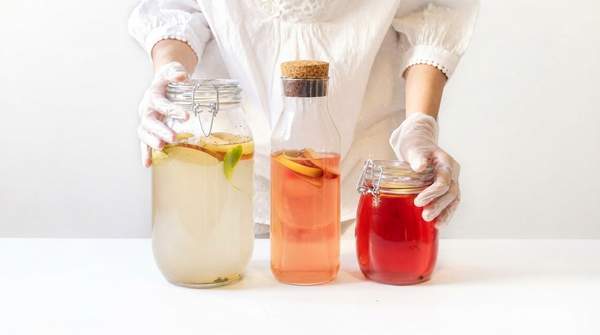
If digestive wellness is your priority, the evidence points to the fermented family. The NRA's 2026 forecast names kombucha, tepache, and prebiotic sodas as drinks positioned to improve the immune system, mood, and digestion, and notes they satisfy growing demand for clean-label, plant-based options. That combination—fermented or prebiotic ingredients plus a familiar soda format—makes this the most approachable category for everyday drinking rather than special occasions.
Immunity-focused tonics form a smaller adjacent cluster. SPINS highlights elderberry specifically, describing immunity-boosting herbal tonics as a very practical mocktail base. The evidence base for this row is thinner than for the others: industry reports name the ingredient and the intent, but do not detail a full benefit profile, so treat elderberry tonics as a mocktail-friendly option with a claimed immune-support angle rather than a well-mapped category.
Who Is Driving This, and Why It Matters for You
The demand behind these categories is generational. Datassential reports that tea consumption during happy hour is notably higher among Gen Z (23%) than older generations, reflecting younger drinkers' preference for non-alcoholic social beverages, and that roughly 58% of consumers believe tea is healthy—making it an attractive base for both alcoholic and non-alcoholic drinks. The NRA's forecast adds that consumers increasingly want customizable health solutions tailored to individual needs, such as electrolyte balances, varied caffeine levels, and cognitive enhancement.
That personalization impulse is exactly why category-level knowledge matters more than brand loyalty. The same social occasion can call for a hop water, a mushroom-elixir seltzer, or a prebiotic soda depending on whether you want to unwind, focus, or support digestion—and the youngest legal-drinking-age consumers are the ones normalizing all three on the same menu.
Making Your Choice: Aligning Beverages with Your Wellness Journey
Health-conscious individuals can make informed choices about functional non-alcoholic beverages by identifying their primary wellness goal—stress relief, focus, gut health, or immune support—and selecting a category with the corresponding key ingredients. In practice: for stress and focus, look for ashwagandha, L-theanine, rhodiola, or Lion's Mane; for relaxation, CBD or hop-based waters; for digestion, kombucha, tepache, or prebiotic sodas; for a mocktail with an immunity angle, elderberry tonics.
Keep the boundaries in view. These are U.S.-market industry trends, the benefits are claimed by product developers and forecasters rather than medically verified, and no specific brand is endorsed here—only ingredient types. The measurable indicator of success is simple: a consumer successfully identifies a functional beverage category and its ingredients that align with their specific wellness objective. Next time you scan a shelf or a cocktail menu, find your goal first, match it to an ingredient signature from the table above, and you will have made that choice.