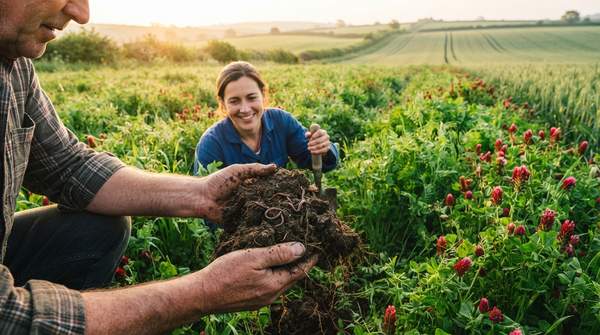
Sustainable farming practices such as regenerative agriculture, crop diversification, and agroforestry improve soil health and biodiversity, and a growing body of research suggests those ecological gains can translate into food with higher micronutrient content. The connection runs through the soil itself: plants draw their nutrients from the ground they grow in, so the condition of that ground matters to what ends up on your plate. Here is how the chain works, and what it means for the way you shop.
The Foundation: Soil Health and Nutrient Density
Concern that modern farming affects soil life in ways that matter to crop nutrition is not new. As soil scientists David R. Montgomery and Anne Biklé note, the idea was recognized in the mid-twentieth century, though a lack of mechanistic understanding hindered mainstream acceptance at the time. Advances in soil ecology have since revealed that soil health plays a major, long-neglected role in sustaining soil fertility—and point to linkages between soil health and the nutritional qualities of food.
The Rodale Institute frames the problem starkly: conventional farming's narrow focus on yields has led to a decline in the nutritional quality of many crops over roughly the last 50 years. California State University's Center for Regenerative Agriculture reports that significant evidence shows higher yields can be correlated with reductions in nutrient density in plants, and that numerous studies point to declining soil quality from certain agricultural practices as a possible cause. The center cautions that more data is needed to determine why—and to identify the most economically sound ways to convert from conventional to regenerative techniques.
Sustainable Practices for Ecological Resilience
Regenerative agriculture is best understood as a holistic approach rather than a single technique. The Natural Resources Defense Council describes its ecological benefits as including improvements in soil health and fertility—the foundation of healthy water, nutrient, and carbon cycling—along with vibrant microbial communities, richer plant, bird, and insect populations, reduced soil erosion, less water pollution due to fewer chemical inputs, and improved water-holding capacity in the soil.
A scientific review of principles for environmentally sustainable agriculture, published in the journal literature indexed by PubMed Central, adds that species-rich ecosystems exhibit greater resilience, reduced dependence on chemical inputs, stronger resistance to climatic stressors, and enhanced overall environmental stability. The Harvard Nutrition Obesity Symposium report on sustainable food systems emphasizes that soil quality, water quality, biodiversity, pollination, and nutrient cycling are interconnected systems that policy and practice should not underestimate or separate.