At home, a simple twist of a knob can power a kitchen scale indefinitely, eliminating disposable batteries and showcasing how minor innovations drastically cut waste. Designs like Fig and Pickle scales shatter the expectation that modern convenience demands disposables or constant external power, offering a blueprint for sustainable kitchens.
Yet, many associate sustainability with higher costs. This is a misconception: numerous eco-friendly kitchen choices actually yield net financial gains over time. The Guardian confirms that careful equipment selection, mindful power use, and even recycling food wraps translate into household savings. Embracing eco-friendly habits isn't just responsible; it's smart resource management.
Companies that prioritize durable, repairable, and resource-efficient kitchen solutions are poised to capture a growing market of environmentally conscious consumers, while traditional disposable models will face increasing scrutiny and obsolescence.
Smart Swaps for a Greener Kitchen
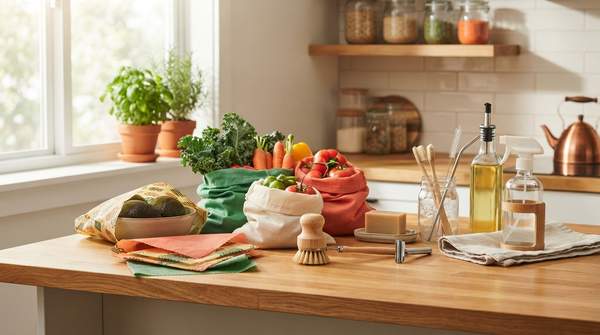
Transforming your kitchen into a hub of sustainability doesn't require a complete overhaul. Strategic swaps of everyday items can significantly reduce waste and costs.
1. Non-aerating Laminar Spray Aerators
Best for: Water-conscious homeowners
These aerators cut water flow to 0.5 GPM for conservation, providing a steady, splash-free stream ideal for precise washing, according to learn. While flow is lower, the water savings are substantial.
Strengths: High water savings; consistent flow; easy installation | Limitations: Lower flow might require longer rinsing for some tasks | Price: Low
2. Replacing Small Components in Faucets
Best for: Budget-conscious DIYers
Instead of replacing entire faucets, opting for new cartridges and aerators drastically cuts waste. This extends fixture life, reducing material consumption and costs.
Strengths: Low waste; cost-effective repair; extends fixture lifespan | Limitations: Requires identifying correct replacement parts | Price: Very Low
3. Durable and Sustainably Made Faucets and Fixtures
Best for: Long-term investors
Investing in durable, sustainably made faucets and fixtures saves time, money, and resources long-term. Designed for longevity and repairability, they minimize future replacements despite higher upfront costs.
Strengths: Long lifespan; reduced resource use; potential for repair | Limitations: Higher upfront cost | Price: Moderate to High
4. Glass or Tritan Food Storage Containers
Best for: Health-focused families
For food storage, glass or Tritan containers avoid potential toxins like BPA and Pfas found in some plastics, as recommended by The Guardian. These materials offer safe, reusable alternatives.
Strengths: Non-toxic; durable; versatile (oven/microwave safe for glass) | Limitations: Glass can break; Tritan may still be plastic | Price: Moderate
5. Donating Unwanted Kitchen Utensils
Best for: Decluttering households
Donating unwanted kitchen utensils to opportunity shops extends product lifespan, reduces landfill waste, and declutters your home, according to The Guardian.
Strengths: Reduces waste; supports community; declutters kitchen | Limitations: Requires local donation options | Price: Free
6. Alternatives to Plastics for Cookware
Best for: Eco-conscious chefs
The Guardian suggests stainless steel, cast iron, copper, and recycled aluminum as durable, non-toxic alternatives to plastic cookware. These materials offer lasting cooking surfaces.
Strengths: Durable; non-toxic; excellent heat retention (cast iron) | Limitations: Can be heavy (cast iron); requires specific care | Price: Moderate to High
7. The Wonderbag (Thermal Cooker)
Best for: Energy-saving batch cooks
The Wonderbag uses no power, significantly cutting energy consumption for batch cooking. Food is brought to a boil, then insulated to continue cooking slowly without additional electricity or gas.
Strengths: Zero energy use; portable; ideal for slow cooking | Limitations: Requires initial heating on a stove; not suitable for all dishes | Price: Moderate
8. Silicone Baking Mats
Best for: Frequent bakers
Reusable silicone baking mats are non-stick without chemicals, replacing disposable baking paper and reducing waste. They are durable and easy to clean.
Strengths: Reusable; non-stick; easy to clean | Limitations: Can retain odors if not cleaned properly; not suitable for high-heat searing | Price: Low
9. Stoneware Baking Dishes
Best for: Traditional cooks
Stoneware baking dishes become naturally non-stick with seasoning, eliminating the need for Teflon or disposable paper. They provide even heat distribution and durability.
Strengths: Durable; naturally non-stick with seasoning; good heat retention | Limitations: Can be heavy and prone to breakage if dropped | Price: Moderate
10. Spaghetti Spoon with a Hole
Best for: Waste-reducing home cooks
A spaghetti spoon with a hole precisely measures one serving, helping reduce food waste through simple portion control.
Strengths: Reduces food waste; simple design; inexpensive | Limitations: Only measures spaghetti | Price: Very Low
Investing in Durability: Water and Fixture Wisdom
| Feature | Benefit | Waste Reduction | Long-Term Cost |
|---|---|---|---|
| Non-aerating laminar spray aerators | Reduces water flow rate to 0.5 GPM for water conservation | Minimizes water waste from daily use | Lower utility bills |
| Replacing small components (e.g. cartridges, aerators) | Extends lifespan of existing faucets | Significantly less waste compared to replacing entire faucets | Avoids full faucet replacement cost |
| Durable and sustainably made faucets and fixtures | Resists wear and tear, designed for longevity | Reduces frequency of replacements, conserving resources | Higher upfront, but saves time and money over time |
Beyond individual swaps, a strategic investment in durable kitchen infrastructure yields significant long-term benefits. Prioritizing repairable fixtures and water-efficient components, like non-aerating laminar spray aerators that cut flow to 0.5 GPM (learn), not only reduces environmental impact but also translates into substantial cost savings over time. This approach shifts focus from disposable convenience to lasting value, making targeted upgrades, such as replacing a faucet cartridge instead of the whole unit, a financially and environmentally superior choice.
As consumers increasingly prioritize both their finances and the planet, companies offering genuinely durable, repairable, and resource-efficient kitchen solutions will likely dominate the market, while disposable models appear destined for obsolescence.