Having a say in how you approach a difficult subject can change the experience of therapy. You might feel ready to reflect on something personal while wanting time to decide how much to share, or which form of expression feels comfortable.
Those choices are central to the trauma-informed approach of Anit Kaur, a qualified art therapist who offers online one-to-one sessions for women. Her work brings creative materials and reflective conversation into a therapeutic relationship paced to individual readiness.
Having a Say in the Process
Trauma-informed practice pays attention to emotional safety, personal agency and the effects that past experiences can have on a person’s sense of control. In Anit’s professional approach, sessions are paced to individual readiness and grounded in informed consent and confidentiality.
That means the pace has a purpose. Someone exploring loss or a difficult relationship may need room to work with what feels manageable, while another person may be ready for a more focused creative task. Neither calls for a predetermined response.
Anit describes her practice as collaborative. Personal meaning-making and the ability to have a voice are central to her approach, giving women an active role in their therapeutic work.
The Materials Can Change, Too
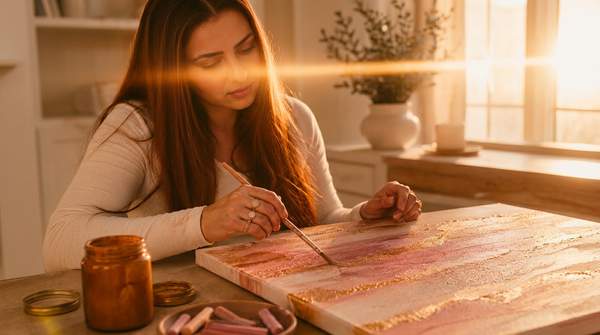
Anit’s professional practice includes mixed media and material-led interventions. Different materials can offer different ways to engage with an experience.
Her approach accommodates practical, focused projects alongside open-ended exploration. A defined creative task may offer something concrete to work on, while a less structured process may leave space for unexpected associations and ideas. These choices belong within individual therapeutic work.
Outside her therapy sessions, Anit maintains an active artistic practice. That relationship with making art gives her work a personal dimension alongside her formal art therapy training.
Making Room for Culture and Identity
Personal experiences are shaped by relationships, family life, culture and social expectations. These influences can affect how a woman understands an experience, what she wants to express and what support feels appropriate to her.
Anit identifies her approach as culturally responsive. As a Singaporean Sikh artist and art therapist, she brings an interest in how individual stories exist within cultural settings, an interest also reflected in her academic research.
Her professional practice includes work relevant to relational and complex trauma, loss, life transitions and questions of identity. Her approach begins with individual circumstances rather than assuming a shared story.
Research That Examines the Therapist’s Role
Anit’s Master of Arts in Art Therapy research at LASALLE College of the Arts examined trauma-informed, feminist art therapy in the context of intimate partner violence in Singapore. More specifically, it considered how artwork created by a therapist in response to her professional experiences could inform practice with women survivors.
Conducted in a crisis shelter, the study drew on therapist-created images, reflective journals, supervision notes and anonymised clinical records. It examined themes including emotional containment, silence, voice and the therapist’s own cultural assumptions.
That focus is relevant to trauma-informed work because a therapist’s assumptions and responses can influence how she approaches sensitive experiences. Anit’s research examines those responsibilities alongside the role of art-making, adding substance to her emphasis on dignity and personal agency.
Individual Support With a Starting Point
Anit’s clinical training included placements with the Singapore Council of Women’s Organisations and United World College of South East Asia. She now offers online individual art therapy sessions for women internationally, drawing on that professional background and her continuing creative practice.
Her booking page invites women to arrange a session directly, with online delivery making her services accessible across locations. The invitation to be met where you are fits naturally with the attention to individual readiness that informs her therapeutic approach.
Frequently Asked Questions
Does trauma-informed art therapy only address past trauma?
No. Anit Kaur’s professional practice also encompasses loss, life transitions and questions of identity. The focus of individual work depends on the person seeking support and her circumstances.
How are personal boundaries approached in Anit Kaur’s sessions?
Anit Kaur describes her therapeutic work as paced to individual readiness and guided by informed consent. Her approach considers personal agency and the importance of respecting individual experiences.
What kinds of art materials are involved?
Anit Kaur’s professional practice includes mixed media and material-led approaches, with both structured projects and open-ended exploration. Activities depend on the individual therapeutic work.
How does cultural background enter Anit Kaur’s approach?
Anit Kaur describes her practice as culturally responsive, recognising the relevance of identity and cultural context to personal experiences. Her academic research examines trauma-informed art therapy within the Singaporean cultural setting.
A Conversation at Your Own Pace
Therapeutic support asks for trust, and part of that trust is having room to make choices about your participation. Anit’s combination of trauma-informed practice, creative approaches and research into the therapist’s responsibilities gives you specific reasons to consider working with her.
To begin working with her, book an online one-to-one art therapy session with Anit Kaur.