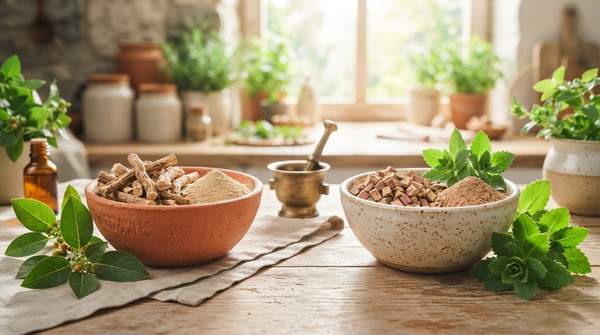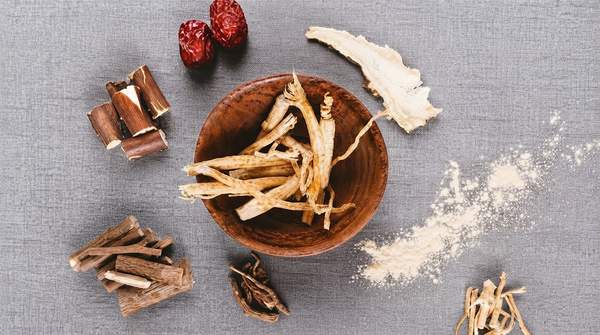
If you already know ashwagandha and ginseng, two quieter alternatives may fit your needs more precisely: holy basil, a centuries-old staple of Ayurvedic medicine often suggested for stress and anxiety, and eleuthero, formerly called Siberian ginseng, which herbalists reach for when someone "works hard, plays hard, and barely sleeps," according to the U.S. Department of Veterans Affairs' Whole Health Library. Both are thought to act on the body's stress-response systems, but neither is a proven cure, and human research remains thin. Here is how to tell which one deserves a place in your routine.
Holy Basil (Tulsi): Your Ally Against Stress
Holy basil, also called tulsi, has been used primarily as a tea in Ayurvedic medicine, where it is often called "the queen of all herbs" or "the incomparable one," as writer Lauren Hunsberger notes in Bellevue Club's Reflections magazine. Its traditional reputation covers stress relief and cognitive enhancement, alongside claims of quelling inflammation and reducing free radicals in the body.
Modern reporting adds a cautious endorsement. TIME's Jamie Ducharme notes that some research has suggested holy basil may help lower stress levels. That is a suggestive, not conclusive, signal—the same article stresses that there is very little human research behind many adaptogen claims and that much more research is needed. Still, for readers whose primary complaint is stress or anxiety, holy basil is the better-supported starting point of the two herbs here, anchored in long traditional use and at least preliminary research interest.
Eleuthero (Siberian Ginseng): Boosting Energy and Supporting Sleep
Eleuthero (Eleutherococcus senticosus) deserves its own category, in part because of a naming problem. The VA's Whole Health Library explains that it was formerly known as Siberian ginseng, a label that created confusion because eleuthero is not in the Panax genus. That distinction matters when you read about side effects, as we'll cover below.
Traditionally, eleuthero has been used to increase vital energy, improve sleep in people bothered by many dreams, improve appetite, and address lower back and kidney pain as well as rheumatoid arthritis. TIME reports that some research suggests Siberian ginseng may help mediate fight-or-flight stress responses, and that people use it to boost the immune system, physical stamina, and sexual health. Herbalists, the VA notes, often use it as an adaptogen for hard-driving, under-sleeping individuals—making it the one herb in this pairing that touches both energy and sleep.
Important Considerations: Research, Side Effects, and Interactions
Before you shop, three cautions apply. First, the science: TIME emphasizes there is very little human research backing adaptogen claims, and much more is needed. UCLA Health's Dr. Dana Hunnes goes further, calling adaptogens and supplements "sometimes… more of a band-aid," and recommending that you instead work with your physician to understand the underlying cause of your symptoms.
Second, side effects—and here the genus distinction is critical. The VA cautions that ginseng (Panax) has the potential to raise blood pressure, can decrease blood glucose levels—so caution is advised in people with diabetes—and, because of its stimulating properties, can cause some anxiety and insomnia. Those warnings attach to Panax ginseng, not necessarily to eleuthero, which the VA describes as generally considered safe in standard doses.
Third, interactions: both UCLA Health and the broader guidance point to talking with your primary care physician before adding adaptogens, especially if you have existing medical conditions or take medications. This article is not medical advice, and no dosing recommendation follows from it.
Your Adaptogen Decision Framework
With only these two herbs on the table, choosing becomes a simple mapping exercise. Match your primary goal to the herb whose traditional use and preliminary evidence point that direction, then qualify the match with the caveats above. The matrix below does exactly that, drawing each cell from the sources described.
| Primary wellness goal | Lesser-known adaptogen | Purported benefits | Evidence & qualification |
|---|---|---|---|
| Managing stress and anxiety | Holy Basil (Tulsi) | Helps the body cope with stress; traditionally used for stress relief and cognitive enhancement | Ayurvedic use over centuries; "some research" suggests it may lower stress levels, per TIME; human data limited |
| Boosting energy and combating fatigue | Eleuthero (Siberian Ginseng) | Increases vital energy; used to improve stamina and physical endurance | Traditional use documented by the VA; some research suggests it may mediate fight-or-flight responses; more human research needed |
| Improving sleep | Eleuthero (Siberian Ginseng) | Traditionally used to improve sleep in those bothered by many dreams | Individual effects vary; VA describes eleuthero as generally safe in standard doses; anxiety and insomnia warnings apply to Panax ginseng, not necessarily eleuthero |
The reasoning behind the matrix is straightforward. Holy basil's documented profile—stress relief, cognitive enhancement, and calming traditional use—concentrates on the stress side, which is why it earns the anxiety row. Eleuthero's traditional uses span both vitality and sleep in restless sleepers, which is why it appears twice. If your goal is stress, start with tulsi tea; if it is daytime fatigue, poor sleep, or both, eleuthero is the one to discuss with your clinician.
Making an Informed Choice for Your Wellness Journey
The decision, then: pick holy basil if stress and anxiety are your primary concern, and eleuthero if your target is energy, fatigue, or sleep quality—but consult a healthcare professional before starting either, especially if you have existing medical conditions or take medications. Your measurable indicator of success is simple: you can name one specific adaptogen aligned with your goal, you understand that neither is a proven treatment, and you have flagged the conversation with your doctor as the next step. If an underlying issue is driving your stress or fatigue, as UCLA Health cautions, that conversation—rather than any herb—is where the real work begins.